Monday, November 27, 2017

DUBAI GOLD AND DIAMONDS

All that glitters is gold - and diamonds! At her work-in-progress showing, German artist and bangaloREsident@Pepper House, Sophie-Therese Trenka-Dalton presents excerpts of photo and video material collected in Kochi, Kozhikode and Malappuram during her residency. Besides her on-going interest in the unique traffic between Kerala and the Gulf States, Sophie explored other subjects like marine traffic, coir, palm fronds and malls.

Sophie-Therese Trenka-Dalton (*1979, Berlin) lives in Berlin. She studied visual art till 2007 at the University of the Arts, Berlin and Cooper Union, New York. After her studies she travelled for projects within Europe, to Los Angeles and to the United Arab Emirates, where she developed central aspects of her current artistic practice. In her research-based installations, Trenka-Dalton examines the processes of cultural shifting and appropriation that occur when centres of power implode and reshape. She retraces the continuous migration of cultural motifs along objects, buildings and stories.


Sunday, November 26, 2017

Botanical Cosmos

Man & Wah are flower boys living and working in Australia. They produce visual works that highlights the intricate forms and colours of plants through large format photographic prints & audio/visual digital projections. These works celebrate the beauty and diversity of nature from around the world, encouraging reflection and deeper contemplation of our relationship with nature, inviting us to pause and appreciate the role it plays in sustaining a liveable planet.
Botanical Cosmos Bengaluru is a series of new botanical inspired works by Man & Wah. Exploring the back streets of the city and Bengaluru’s renowned City Market, Man & Wah with the help of the Shanthi Road crew collected an array of plants within the city’s rapid concrete developments. They visually captured each plant's unique forms and vivid colours through still images and video works that reveal a new sense of perspective and connection with nature that seems to be quickly disappearing amongst this city’s modern expansions.


Friday, October 27, 2017

Monuments by George Demir

In his work Monuments George Demir examines people’s life-stories and their social
positions and poses the question of social representation.
Monuments touches on mutual issues and circumstances as a fragment of self-
representation, on a universal level, through biographical interactive conversations
with different people that have different lifestyles, different sexualities, different
gender-identities and of course different stories.
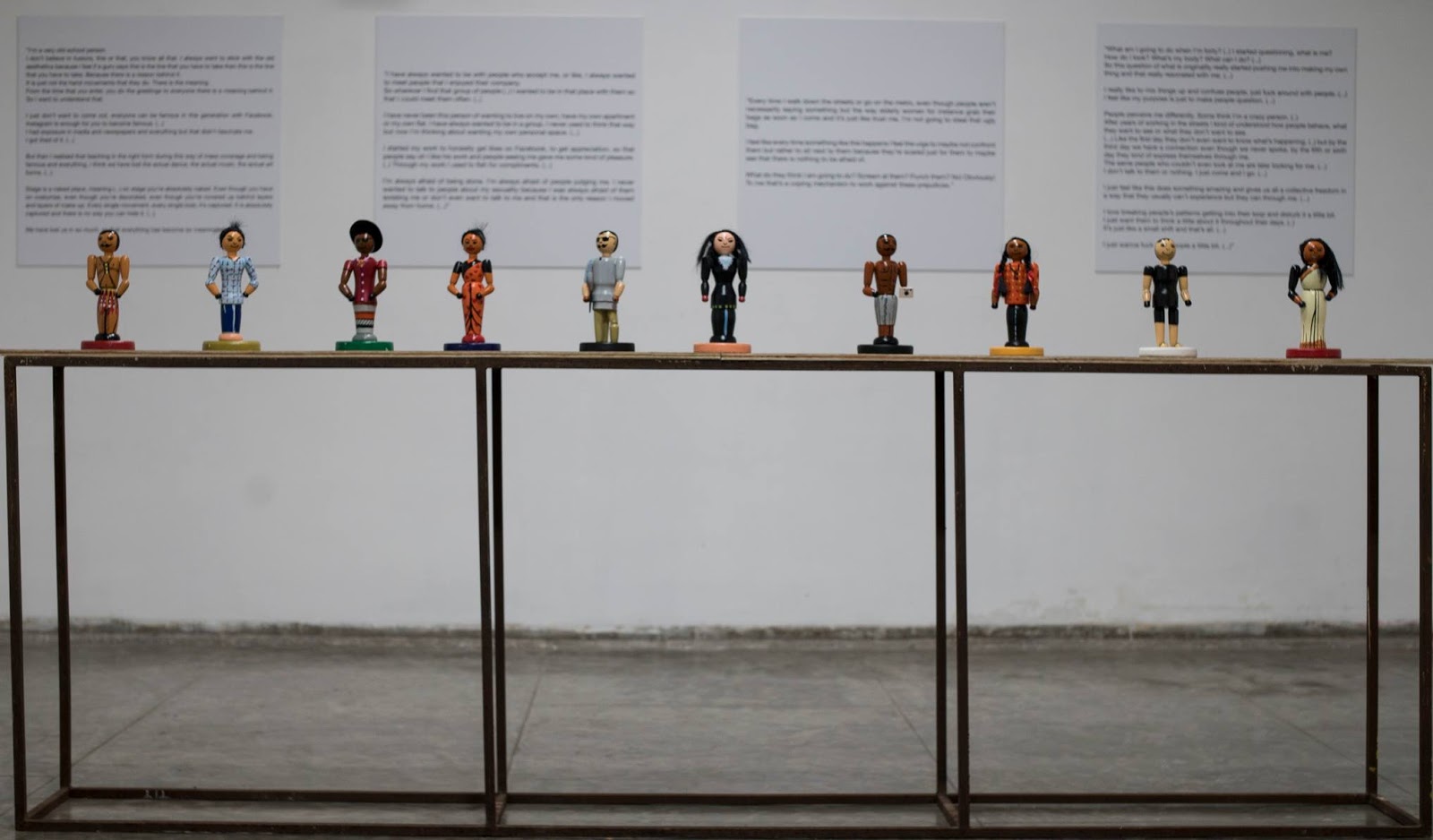
George Demir utilises the traditional art form of Channapatna dolls in order to present
a form of representation but also transporting the handcraft into a rather
contemporary time, as being a monument to a pluralistic public trying to look forward
to the transformation on how we perceive ourselves and the society we live in.


Tuesday, October 24, 2017

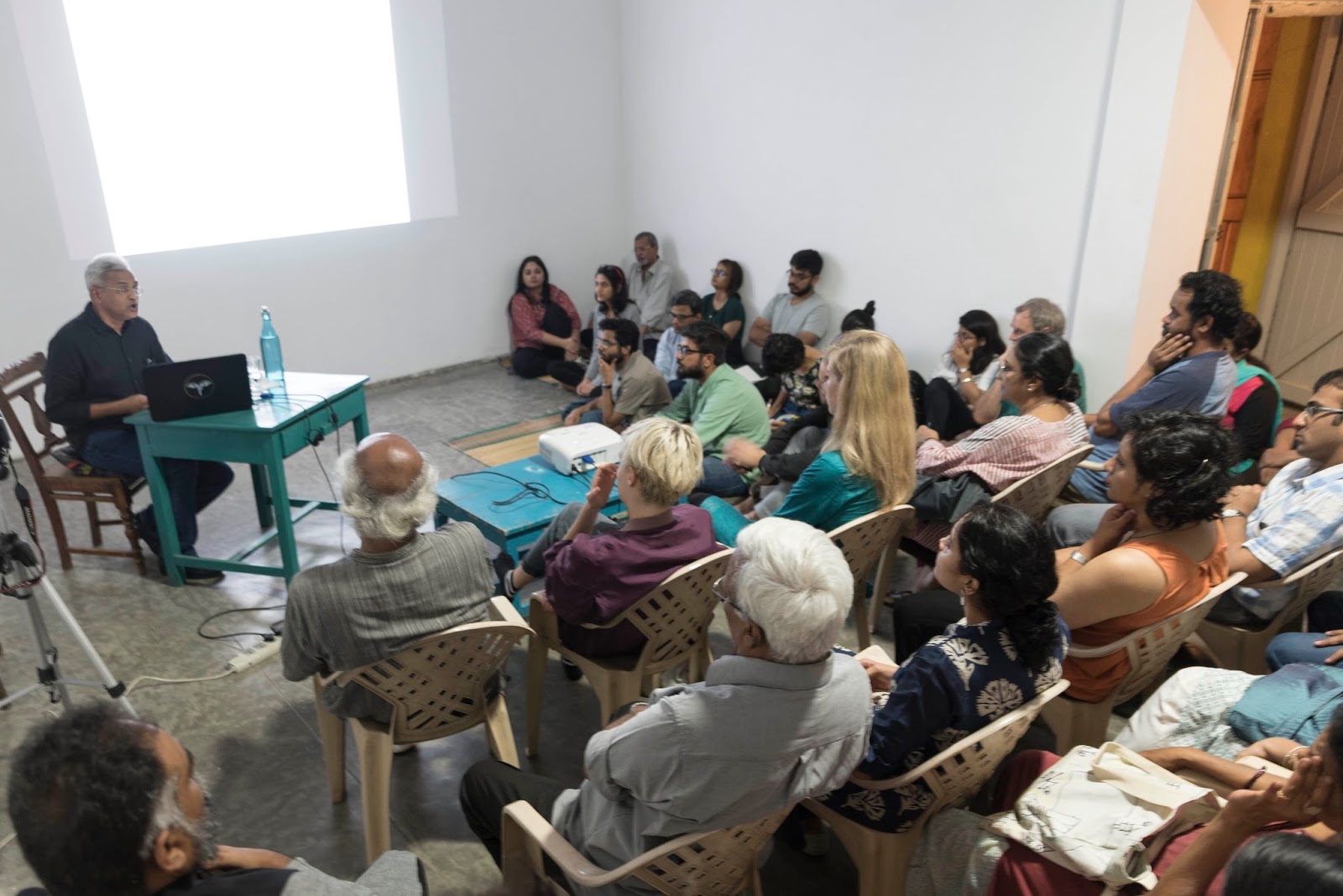
For a Nation Without a Narrative: How was Modernism in India? a lecture by Pithamber R. Polsani

About the talk
Twenty-five years back Geeta Kapur asked the question “When was Modernism in India?” and in response, located the Indian modernism in disjunction with the West, in a fractured temporality.  Perhaps it’s time to revisit this question again not with the view of positioning it accurately in time and space, but instead to critically examine the very notion of modern and by extension the idea of contemporary within the context of art in India.  In an age of “post” of everything—post-modernism, post-history, post-capital, post-labour and even post-human—it may seem anachronistic to ask the question of modernism and modernity.  However, the question remains relevant because we are yet to overcome the metaphysics of modernity. Therefore, my contention is that as long as we have one ear to the West and operate in its shadow we will miss the call to genuinely think other possibilities that were opened in the past and that may unravel in the future.

About the Speaker
Pithamber traversed diverse disciplines: philosophy, education, technology, management, literature, semiotics, media, psychoanalysis, art and Spanish language. These explorations have given him the capability to synthesize insights from multiple domains and connect hitherto unconnected things in a unique way to arrive at solutions to conceptual and practical problems. Prior to joining Srishti as faculty, Pithamber led learning Academies for Royal Bank of Scotland & Nokia Siemens Networks, and at Satyam Computer Services established a Virtual University. Before joining the corporate sector Pithamber taught at the University of Arizona, Bates College & Delhi University. Pithamber received his PhD (1997) from Purdue University, West Lafayette and MPhil & MA from Jawaharlal Nehru University, New Delhi. Some of Pithamber’s publications include, “The Image in a Fatal Kiss: DalĂ­, Lacan and the Paranoiac Representation”, “Like A Lizard That Junks its Tail in Distress: Homer Simpson is no Antigone”, “Use and Abuse of Learning Objects,” “Riding the Satellite to the Millennium.  At Srishti, Pithamber is a Faculty and the Dean of the School of Advanced Studies and Research.


Monday, October 2, 2017

Still visible Raj Kumar- Talk by Anil Kumar HA

About the talk:
Referring to the late Kannada film star Dr. Rajkumar, a cultural theoretician said that 'a cultural hero' is construed when politics fails to produce one (K.V.Narayana). A writer complemented him saying that this man started playing the role of 'Rajkumar' and never removed his make up till the end (Devanooru Mahadeva). A film critic said that in his appearance as Rajkumar, he reminds us of a Brahmin boy from the Mysore province (M.K.Raghavendra). A Jnanpith awardee said that his major films should be subtitled into several Indian languages and be telecast regularly, from the moralistic point (U.R.Ananthamurthy). He is still very much alive in the sacred and profane public spaces. For almost half a century he had been familiar to us through the still photos--published and stored. Yet the promised (allegoric or otherwise) museum about him is yet to take a shape. This is the story of an artist who ruled the hearts of many generations, was a live model for morality-in-art; where even the ruling class was ruled by him while defining artistic policies. 

In this backdrop, this presentation is about unleashing a specific cultural memoir of a generation from the last five decades, which was affected by the process of watching one still image that altered, changed, agreed but refuses to perish. It includes personal anecdotes, stories and analysis about his identity as a hero, singer, protagonist of a linguistic autonomy; and last but not least, as an artist.


About the Speaker:
H. A. Anil Kumar writes, teaches and speaks about visual culture in English and Kannada. He studied Contemporary Curation in Royal College of Arts (London), Art History (Kala Bhavana, Santiniketan) & Painting (CKP). His writings have meandered through art journalism, art criticism, art history, monographs, catalogues, art travelogue and graphic novel formats. His books include the monographs as well as travels to Finland, Russia and Santiniketan. He is also a translator and has translated most of the NGMA (Bangalore) exhibition publications. He has translated John Berger's "Ways of Seeing" to Kannada. He is a recipient of fellowships, scholarships and awards from Unesco-Aschberg Fellowship, Pro-Helvetia, Charles Wallace Trust, B.C.Sanyal's 'Dedicated Teacher' award as well as 'Best Communicator' award from PRCI. Currently he heads the Dept. of Art History at the College of Fine Arts, Karnataka Chitrakala Parishath, Bengaluru.