Sunday, May 13, 2018

AATMASPHERE (Chapter V)

AATMASPHERE (Chapter V)
AN EXPLORATION OF POLYTONALITY & MOVEMENT
AS AN EXPERIMENT IN CONNECTING SOULS

The Aatmasphere is a sonic experiment exploring the hidden power of
The Fourth Way Enneagram, a nine-pointed form designed by G.I.
Gurdjieff in 1949. The idea of the installation is to use live music
and movement within a circle by engaging different sets of musicians
and dancers experimenting and improvising in the here and now.


Saturday, May 5, 2018

Satish Muthalli recently received the National award from the Lalith Kala Academy for his work that featured a rural still life that featured agricultural implements. This work instantly identifies with his agricultural background as a farmer and an artist who is close to nature and concerned about all creatures. The preoccupation of Satish is very specific, he has been focusing on two concerns in his work with rural objects that represent the labor of farmers, who have been neglected by the government and have been burdened by loans, and incidents of farmer suicides in the country is alarming and the inconsistent rains have always affected their lives. The artist represents this predicament and also focuses on his identity as a farmer.
In another set of works, Sathish Muthalli is concerned about animals and the impact of humans on their existence. In reality, we have caged and confined them to restricted zones like safaris and nature parks. They no longer roam the earth freely.
Humans have used and abused their intellect as superior beings on this planet and have constantly interfered with nature. As the philosopher, Rene Descartes wrote in the late 1600s: "animals are mere machines but the man stands alone”. Charles Darwin was one of the first to speak out against this idea. In the Descent of Man, - "There is no fundamental difference between man and the higher mammals in their mental faculties" and that all the differences are "of degree, not of kind".
The key is presenting the subjects with dignity, contrary to the graphically shocking approach activist groups often take. The artist juxtaposed man and animals in ironical situations that question our reality as humans and our violence against the animal kingdom.


We once viewed ourselves as the only creatures with emotions, morality, and culture. But the more we investigate the animal kingdom, the more we discover that is simply not true. Many scientists are now convinced that all these traits, once considered the hallmarks of humanity, are also found in animals. If they are right, our species is not as unique as we like to think. We are part of this ecosystem and need to envision an ethical way of life.

Monday, March 19, 2018

Flexology a lecture by Ravikumar Kashi

RELOOK [ 40] : Lectures on Indian Art
Curated by Pushpamala N.
'FLEXOLOGY'
- a study of street narratives

A lecture by
Ravikumar Kashi
Artist, writer and teacher, Bangalore
On
Monday 19 March 2018 at 6.30 pm
at 1.Shanthi Road Studio/ Gallery, First Floor,
Shanthinagar, Bangalore 560027
About the talk
Amidst the various street visuals that compete for attention on Bangalore's streets, there has been a new and sudden spurt in recent times. This has to do with the vast number of Sene (armies) that have been showing up in Bangalore in particular and Karnataka in general. These
Sene have been coming up in the name of the language, caste/community and film stars. The arrival of such groups is announced by putting up flex banners and posters. Ravikumar Kashi has been documenting them and has studied the street narratives; he will share his observations in this lecture.
About the speaker
Ravikumar Kashi is an artist who works in different mediums such as painting, sculpture, photography, and installation. His works combine or cut across defined expectations from these mediums. His idea/concept driven works are layered and offer themselves to multiple readings.Kashi was born in Bangalore in 1968. He completed his B.F.A. from College of Fine Arts, Bangalore in 1988; M.F.A. from Faculty of Fine Arts, M.S. University, Baroda in 1990; and M.A. in English from Mysore University, in 1995. He learned handmade papermaking from Glasgow School of Art, U.K. He also learned Hanji, traditional Korean papermaking, from Jang Ji Bang, Korea. He has shown his works in solo shows and curated shows across the world in galleries, art fairs, biennales and museums. He has received the National Award from Lalit Kala Akademi, Delhi and two awards from Karnataka Lalit Kala Academy and one from Karnataka Shilpa Kala Academy for his works.
He writes on art in Kannada and English. Two of his Kannada books, 'Anukta' and 'Kannele' have been published from Akshsra Prakashana, Hegggodu. His book 'Kannele' has received Karnataka Sahitya Academy award.
He teaches at RV School of Architecture, Acharya School of Design and Azim Premji University as visiting faculty. He lives and works in Bangalore.
RE-LOOK - Lectures on Indian Art
This series of lectures presents exciting new research being done in the areas of art history, art practice and visual anthropology in India, each for the first time in Bengaluru. Distinguished art historians and scholars are invited to give illustrated papers on their recent work and interests. The lectures take place at the popular artist space 1.Shanthi Road, situated in the heart of the city. The lectures are conceived and programmed by Pushpamala N, supported by Somberikatte, and hosted by 1.Shanthi Road.

Somberikatte :
Somberikatte is a Kannada word meaning idler’s platform- usually the platform around a large tree, an adda, where people gather to gossip and exchange news. It is a fictitious institution, sometimes a forum
, created by the artist Pushpamal a N.





Saturday, January 20, 2018

Reminiscing Evoloution - Works by Appajaiah K S


Appajaiah K.S is an artist, teacher and an arts administrator at the College of Fine Arts, Karnataka Chitrakala Parishath. The traditional Mysore paintings has inspired and enriched Appajaiah’s sensibilities from his early days. The language of the iconic paintings that encapsulate lyrical linearity have been sacred and profane subjects.


Being a modern artist, he has been carrying the pressures of tradition to speak about the self in diverse ways. His show, ‘Reminiscing Evolution’, is a culmination of many explorations, from the memories of his own childhood, from growing up in an agricultural family that was coming to terms with the new realities of change and conflict, Appajaiah has managed to incorporate all of this by working with traditional materials like gesso, gold leaf and vibuthi blocks (sacred ash) in the form of painting and installations. Additionally, there is a conscious effort to speak about himself through photographic images, taken and borrowed from his own family albums. These images are autobiographical in nature and confront us to unravel many personal narratives of anxiety, tensions between the private and public, and the juxtaposition of tradition and modernity.


Appajaiah’s work also looks into the exploration of material, seen as an interesting indulgence, that uses the vibuthi blocks as a metaphor to represent building blocks, further inscribing images of the self and his lived reality on these supposed building blocks. It constructs another reality of fragile memories for us.


Sunday, January 14, 2018

This must be the place - Exhibition of Photographs and Drawings by Lukas acton

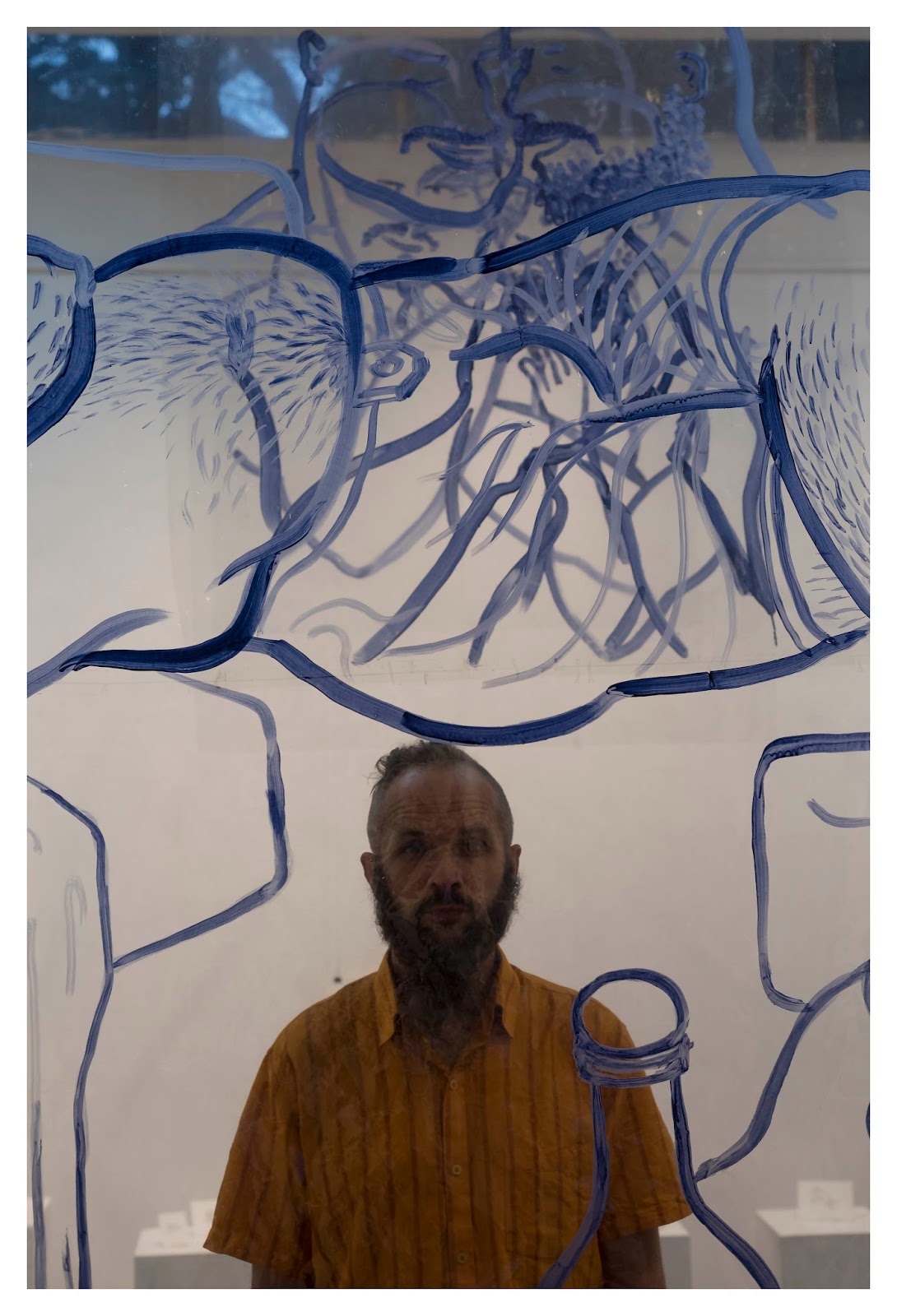
Construction sites are zones of destruction, transition and re-creation. For a short time, a place becomes inhabited and animated by workers who will probably cannot afford living in what they are building. May the assignment of an architect be highly valorised in this society, the labour of construction workers will become unnoticed and stays unthought of. Their art of construction and creation will be there in a very concrete way but also vanishes as their outcome becomes a vessel to be filled with other people’s lives. This photographic essay captures this place of transition to catch some insights of in site ready-mades or ready-to-be-mades admiring their installation work in an artistic sense. This Photo essay is juxtaposed with another set of works-- THE HAIR ON MY BODY HAS BECOME HAPPY, a large-scale drawing installation inspired by and based on studies of Indian paintings and celebrates same sex desire. Lukas works as a photographer, screen printer, illustrator and artist in Bern, Switzerland. In 1 shantiroad studio/gallery he will be showing his recent works from travelling through South India and staying in 1 shanthiroad for 5 weeks.